AI-OS is the single source of truth for everything AI in your dev workflow. Spec → Verifier → Environment as real workflows, ~300 skills shared across every CLI, MCP servers as declarative YAML, all restored with one command.
// new Mac to full AI setup in ~5 minutes.
Most devs who use AI assistants daily end up with skills scattered across
~/.claude/, ~/.codex/, MCP servers hardcoded with no version control,
and the Spec→Plan→Execute→Verify loop living only in their head. AI-OS puts all of it
in one git repo.
Karpathy's framework as 5 recurring workflows, 3 hard rule-sets, and 3 verifier gates applied after every task.
14 required superpowers + ~300 curated & vendored skills, symlinked into Claude Code, Codex, Gemini, Antigravity, Hermes & MiniMax.
10 MCP servers as declarative YAML, generated at install. zsh, Warp, Brewfile & git config versioned in the same repo.
macOS, Linux & Windows CI validate the install scripts on every PR. The setup is idempotent and has a dry-run mode.
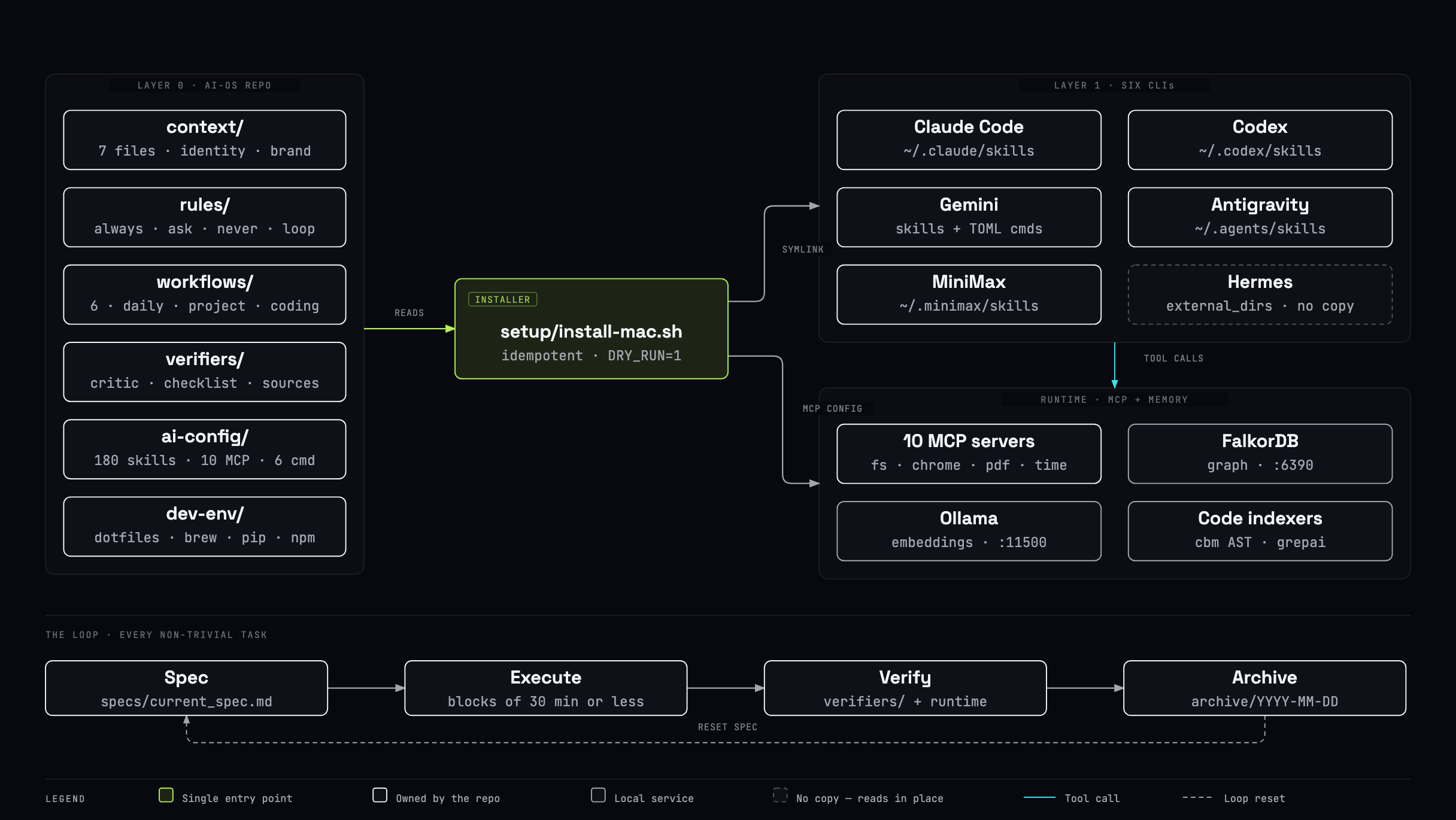
Skills and config flow down from a single repo into every CLI, and every CLI reads from the same shell & system underneath.
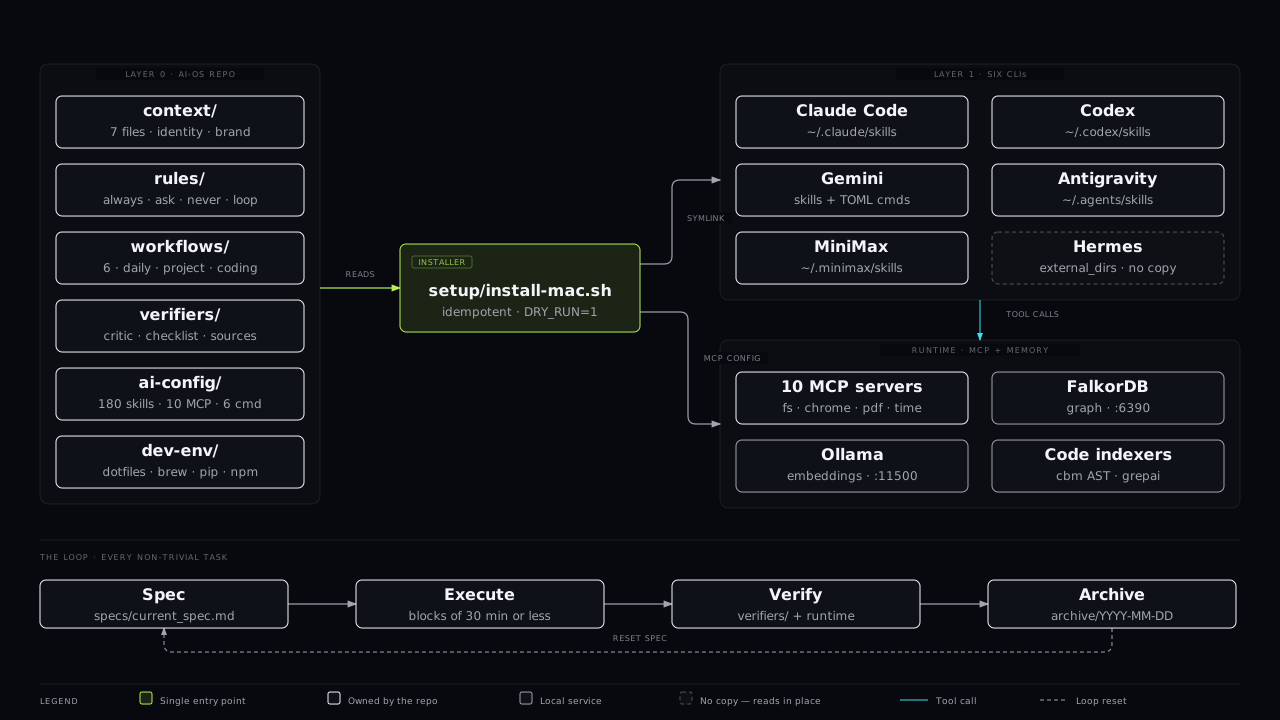
diagram-design skill, skinned from context/06_brand.md.
18 master instructions in CLAUDE.md, 7 context files, 6 workflows, 4 rules, 3 verifiers, flat global skills + optional ECC / claude.tools bundles, and a replicable dev-env. Change it here, it propagates everywhere.
The installer never breaks on re-run. DRY_RUN=1 simulates the whole thing without touching your system.
Claude Code · Codex · Gemini · Antigravity · MiniMax · Hermes. Each reads skills from its own home dir, but those dirs are symlinks back to AI-OS. One edit, six assistants updated.
zsh + Oh My Zsh + p10k + Warp on Mac, PowerShell + Windows Terminal on Windows, Homebrew / apt underneath.
27 editorial diagram types via the vendored diagram-design skill — self-contained HTML + inline SVG, dark-first, skinned from one token file. No Mermaid-slop, no shadows.
Click on any command in the sidebar to simulate execution and query detailed specs, configuration files, environment variables, and wiring methods of the AI-OS.
Five surfaces: slash commands that work in any CLI, AI-OS skills you call by name, the ai-os shell CLI, the installers, and how each client enters a session.
/actionIdea to reviewed code in one command: spec → plan → build → review, without stopping between phases.
/fullThe complete delivery chain: spec → plan → build → review → code-simplify → ship.
/gen-htmlGenerate a rich, responsive, self-contained HTML document from a description — or convert an existing .md/.mdx file.
/saas-reviewWhole-app design review: enumerate and visit every route, audit each screen against the expensive-UI criteria, report prioritised findings, then apply the approved fixes.
/sass-reviewAlias of /saas-review — catches the common "SaaS" typo instead of failing.
/fix-ui-uxFull Impeccable remediation pass: context + audit + critique, targeted repairs, then polish and document.
ai-os-quickstartOne-line bootstrap in a fresh CLI: verifies the 14 required superpowers are installed, runs setup, confirms the environment is ready.
ai-os-karpathyLoads the full Spec + Verifier + Environment method plus persistent context — profile, projects, preferences, tools, sources.
ai-os-memoryOperate and inspect the memory stack: graph status, project indexing, semantic code search, graph browsing.
ai-os-loopBuild and run reusable loops — the 4-file system (TASK, INSTRUCTIONS, PROGRESS, outputs) with 6 blast-radius safety levels.
diagram-design27 editorial diagram types as self-contained HTML + inline SVG, skinned from context/06_brand.md. The diagram above came from it.
ai-os CLIai-os bootstrap [--refresh]First-time or on-demand full-stack setup, then auto-index every project.
ai-os memory statusFalkorDB + Ollama + MCP health with node and edge counts.
ai-os memory start | stop | logsFalkorDB container lifecycle. stop preserves the data; logs tails it.
ai-os memory query "<q>" [path]Semantic search across indexed code via grepai.
ai-os memory search "<q>" [path]Same, but falls back to the AST index when grepai isn't running.
ai-os memory reindex [path]Refresh the codebase-memory-mcp AST index.
ai-os memory browse | visualizeOpen the FalkorDB web UI, or every memory UI plus grepai status at once.
ai-os loop ls | add <dir> | rm <id>List loops, register one (needs TASK.md + LOOP_INSTRUCTIONS.md), or mark one removed while keeping its directory.
ai-os loop status | show | run | pause <id>Inspect a loop's files, level and last activity; cat its PROGRESS.md; open a terminal at it; or disable its scheduling.
npx @edd_remonts/create-ai-osBootstrap from nothing — clones the repo and runs the right installer for your OS.
bash setup/install-mac.shThe full Mac install. Idempotent — safe to re-run. Honours SKIP_BREW, SKIP_NPM, SKIP_PIP, SKIP_MCP and friends.
powershell -File setup/install-windows.ps1The Windows equivalent, same guarantees.
bash setup/install-mac.dry-run.shSimulates the entire install against a temp HOME, touching nothing real. This is the CI gate on every PR.
bash setup/verify.shVerifies a live install: 19 required checks (skills, adapters, superpowers, per-machine env isolation) plus optional ones that warn instead of failing.
bash setup/install-ecc.shWires the vendored ECC bundle — 271 skills, 28 hooks, agents — into the core CLIs.
bash setup/install-claude-tools.sh [--check]claude.tools + gstack skills and the Codex plugin. --check validates structure only, for CI.
claude · codex · geminiNothing to pass. Each client's global instruction file is a symlink to the rendered AI-OS bridge, so context loads on start.
hermes chat --skills ai-os-quickstartHermes takes skills as a flag; it reads the shared skills directory natively via skills.external_dirs.
cat CLAUDE.mdThe escape hatch for any client without a global instruction file — paste it at the start of the conversation.
Spec quality first, verifier passes second, runtime evidence third. No “it builds, ship it.”
One active spec: objective, acceptance criteria, non-goals, risks.
Blocks of ≤30 min, dispatched in parallel when independent.
Verify after each block. Sub-agents self-report; you check the handles.
Quality checklist, self-critique, source-check. Evidence before “done”.
Pick your OS. Copy the block. Most of the 30–60 min first install is just downloading packages.
# 1. bootstrap (clones + runs the Mac installer) npx @edd_remonts/create-ai-os cd ai-os # 2. verify (12 health-check sections) bash setup/verify.sh
# PowerShell as Admin: bootstrap (clones + runs the Windows installer) npx @edd_remonts/create-ai-os cd ai-os powershell -ExecutionPolicy Bypass -File .\setup\verify-windows.ps1
# Debian / Ubuntu: same bootstrap, cross-platform installer npx @edd_remonts/create-ai-os cd ai-os bash setup/verify.sh
git, curl and an internet connectionsetup/install-ecc.sh: +271 ECC skillssetup/install-claude-tools.sh: +12 claude.tools / gstack skillsDRY_RUN=1: simulate without touching your machineThe installer prints this list and asks for confirmation before touching anything. Nothing is installed silently.
git, gh, node, python, uv, go, rust, docker, kubernetes-cli, terraform, ansible, ripgrep, fzf, bat, eza, lazygit, ollama, helm… Homebrew
VS Code, Warp, iTerm2, Windsurf, Docker Desktop, Chrome, Firefox, Raycast, TablePlus, Postman, KeePassXC + 4 Nerd Fonts… Homebrew casks
claude-code, codex, gemini-cli, MCP servers, typescript, vite, eslint, prettier, biome, turbo, nx, repomix… via pnpm
ruff, black, mypy, pytest, ipython, pandas, numpy, httpx, typer, bandit, pip-audit, poetry, mcp… isolated uv venv
Symlinked into every CLI (Claude, Codex, Gemini, Hermes, Antigravity) plus the 14 required superpowers skills. ai-config/skills
Memory stack (FalkorDB + Ollama + Graphiti + code indexers via Docker), 5 global commands (/action /full /gen-html /saas-review /fix-ui-ux), MCP config, Oh My Zsh + Powerlevel10k, dotfile symlinks. background layers
Stop reconfiguring six CLIs by hand. Put the method, the skills and the environment in one repo, and bring it back in one command.